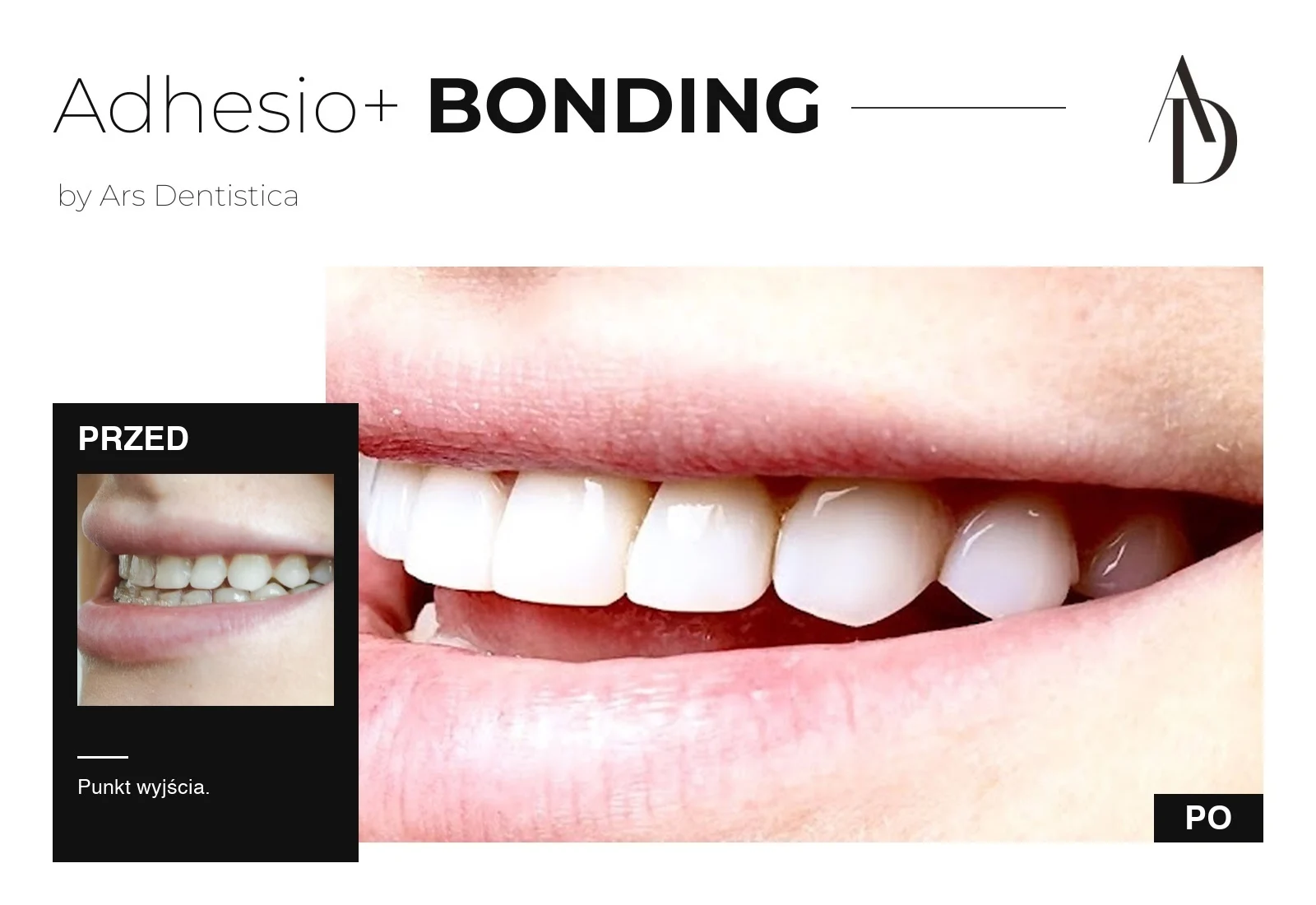
Teeth bonding is the reshaping or rebuilding of teeth with composite material, done directly in the dental chair. It lets us rebuild chipped edges, improve proportions, close small gaps and correct selected irregularities.
A natural result, however, starts earlier than most patients assume. What matters is not only how the teeth are modelled, but also how their surface is prepared, with a good bond in mind and with as little interference with the tissue as possible.
At Ars Dentistica we have developed our own protocol, Ars Dentistica Adhesio+, in which the surface is prepared with an erbium Er:YAG laser. Below we explain how much bonding costs, how it differs from veneers, what the laser actually contributes and where the limits of the method lie.
What is teeth bonding
Bonding means applying composite material directly onto the tooth, shaping it and curing it with light. Everything happens during the appointment, with no impressions, no scans and no dental laboratory.
Composite lets us add material where it is missing and correct the shape where the proportions spoil the look of the smile. The shape of the tooth follows the artistic vision of the treating dentist, agreed with the patient. This is a procedure on the border between dentistry and art. Most often we use it to rebuild chipped or worn edges, close small gaps, improve the proportions of the front teeth and mask individual discolourations.
Whether the result looks natural is decided by details patients usually do not name, yet notice at once: the length and line of the incisal edges, the proportions between the teeth, the shade, the translucency and the way the surface reflects light. That is why we build the composite up in layers rather than as a single mass, often combining several composite shades to obtain a beautiful, natural effect.
Bonding is sometimes called remodeling or layering. These are names for the same procedure.
How much does teeth bonding cost
At Ars Dentistica we quote prices per tooth, as ranges, because rebuilding one chipped edge is a different job from planning the symmetry of the whole front section, sometimes together with raising the occlusion.
Veneering a tooth with high aesthetic composite costs 800 PLN. Veneering with recontouring, that is a shape change as part of full bonding, costs from 1150 to 1350 PLN per tooth. The same procedure in the Adhesio+ by Ars Dentistica protocol, in which the enamel is prepared with an erbium laser instead of a bur, costs 1400 PLN per tooth.
For full bonding of four teeth the indicative cost is from 4600 to 5400 PLN, and for six teeth from 6900 to 8100 PLN. That is the order of magnitude; a detailed quote is possible only after a consultation.
Four things drive the quote: the number of teeth, the extent of the rebuild on each of them, the need for earlier treatment such as hygienisation, caries treatment or root canal treatment, and whether we are planning a single correction or a change covering the whole front section.
We give a detailed quote after the consultation, once we know the condition of the teeth and the extent of the planned change. We cannot give a reliable quote over the phone, because without a clinical examination, without looking at the teeth, it would be guesswork and could mislead the patient. You will find the full list of services in our price list.
Bonding or veneers
This is the question we hear most often at consultations, and we will answer it straight: it takes a clinical consultation.
Bonding belongs to conservative dentistry. The dentist works directly on the tooth, usually during a single visit. The material can later be repaired or adjusted locally. With an additive change, meaning one based on adding composite, the enamel stays intact. Composite loses its gloss over time and can pick up stains, so it needs periodic polishing and, after some years, correction or replacement.
Porcelain veneers are a prosthetic treatment. They are made in a laboratory and require at least two visits. They are more durable and more resistant to staining. Classic veneers, however, require the teeth to be prepared by removing part of the enamel, and that decision cannot be reversed.
Composite veneers sit in between. They are made of the same material as bonding but cover the whole labial surface of the tooth. They share both the advantages and the limitations of the material.
No solution is better in general; a solution is better in a specific situation. For a small shape correction bonding is usually enough and leaves the door open for the future. For a large change of colour or an extensive smile reconstruction, veneers are sometimes the more appropriate choice.
If you are hesitating, you can always start with bonding. From prosthetic veneers there is no going back to your own enamel.
Does bonding damage your teeth
The most common worry before aesthetic treatment is not about the price or the result, but about what will have to be taken away from the tooth. The worry is justified, because enamel does not grow back once it has been removed.
In many cases bonding is an additive method, which means the improvement comes from adding material rather than from removing tissue. That is how it works when rebuilding edges, closing small gaps and correcting proportions. Grinding, which patients also call filing down, is then not needed.
The surface of the tooth does, however, need to be prepared so that the composite bonds with it. This applies to every method, the classic one included. In the traditional approach to bonding the preparation is done with a bur, and a very thin layer of tissue is then lost. The bur also leaves a smear layer on the surface, a deposit of fragmented tissue lying exactly where the bond is meant to form. So no grinding does not mean no interference at all in this case. It means that the extent of it is extremely small and controlled.
It looks different with classic porcelain veneers, where preparing the tooth usually involves removing a layer of enamel across the whole labial surface. That is an irreversible decision and it is worth making it consciously.
Not sure whether this is the right solution for you? Book a consultation
Ars Dentistica Adhesio+, laser surface preparation
Ars Dentistica Adhesio+ is our protocol for bonding, in which the tooth surface is prepared for the bond with the composite by an erbium Er:YAG laser rather than by a bur.
Following the idea of minimally invasive dentistry that we subscribe to, we want the extent of interference to be as small as possible. The Er:YAG laser lets us treat the surface without a rotating instrument touching the tooth, and the amount of tissue affected is kept to a minimum.
For the patient this means a different experience at this stage: without the characteristic pressure, vibration and sound of a bur. Many small corrections can therefore be done without anaesthesia.
The laser does not replace every stage of preparation. After using it we etch the enamel to obtain the bond and apply the bonding system that joins the composite to the tooth. These stages serve different functions and complement each other. The research is unambiguous here: the best results come from a laser combined with adhesive preparation, not instead of it.
Laser treatment, adhesive preparation and aesthetic reconstruction form one planned process in our clinic.
How the Er:YAG laser works
The Er:YAG laser emits light with a wavelength of 2940 nanometres, strongly absorbed by the water present in dental tissue. The absorbed energy makes that water evaporate rapidly, which at the right settings produces a controlled treatment of the surface layer, prepared for the bond.
What forms is an irregular, microretentive surface that the bonding system penetrates, and it forms without the smear layer that comes with rotary instruments. The heat produced by the evaporation is carried away by water cooling, which runs throughout the procedure.
The laser also has a threshold below which it removes nothing. The amount of tissue affected follows from the settings, not from the way the instrument is guided. In the Ars Dentistica Adhesio+ protocol we work within a defined range of settings.
We use the same type of Er:YAG laser in a research project on developing a root canal treatment procedure, co-financed by European Union funds.
Teeth bonding before and after
Below is work done in our clinic. Closing a diastema and rebuilding the incisors with composite material, in a single visit, using the additive method.
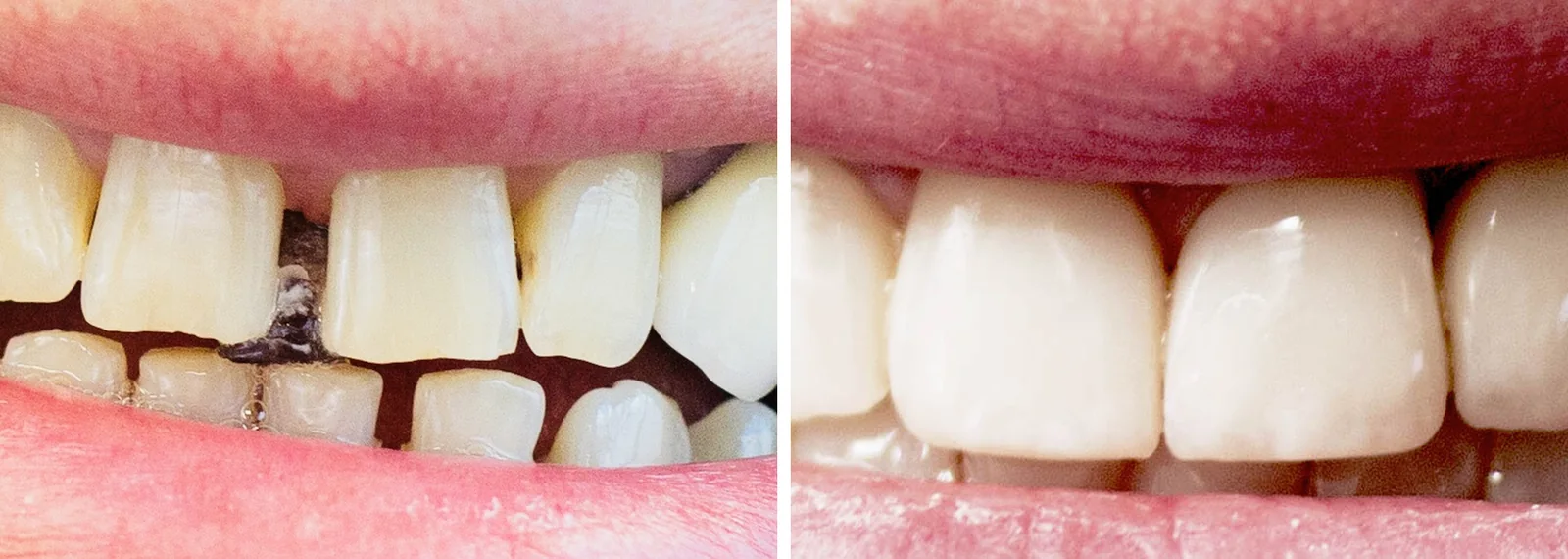
Notice what is not obvious at first glance: the shape of the incisal edges and the contact between the central incisors look natural, because they were modelled in layers rather than filled with a single mass. That part of the work is what decides whether a restoration is recognisable as a restoration.
Who bonding is for, and who it is not for
Bonding works where composite material can deliver the right aesthetic and functional result. Most often it helps with:
- rebuilding chipped or worn tooth edges,
- closing small gaps, a diastema included,
- improving the shape and proportions of the front teeth,
- correcting selected irregularities and discolourations,
- completing orthodontic treatment aesthetically,
- raising the occlusion where prosthetic solutions are not needed.
It is usually not the recommended solution when a tooth is very heavily damaged and needs a crown, when the problem is the position of the teeth in the arch, because that is a job for orthodontics, and when the expected change of colour goes beyond what composite can deliver.
Before the procedure we assess the condition of the teeth, the gums and the bite. If teeth are wearing down or chipping, we look for the cause first and take it into account in the treatment plan. Rebuilding the shape alone is not enough if the overloads that caused the damage remain. We say this plainly, because we see patients who were promised bonding for an orthodontic or an occlusal problem. In such situations we start by diagnosing and resolving the cause of the problem, and sequence the treatment accordingly.
Bonding after orthodontic treatment and whitening
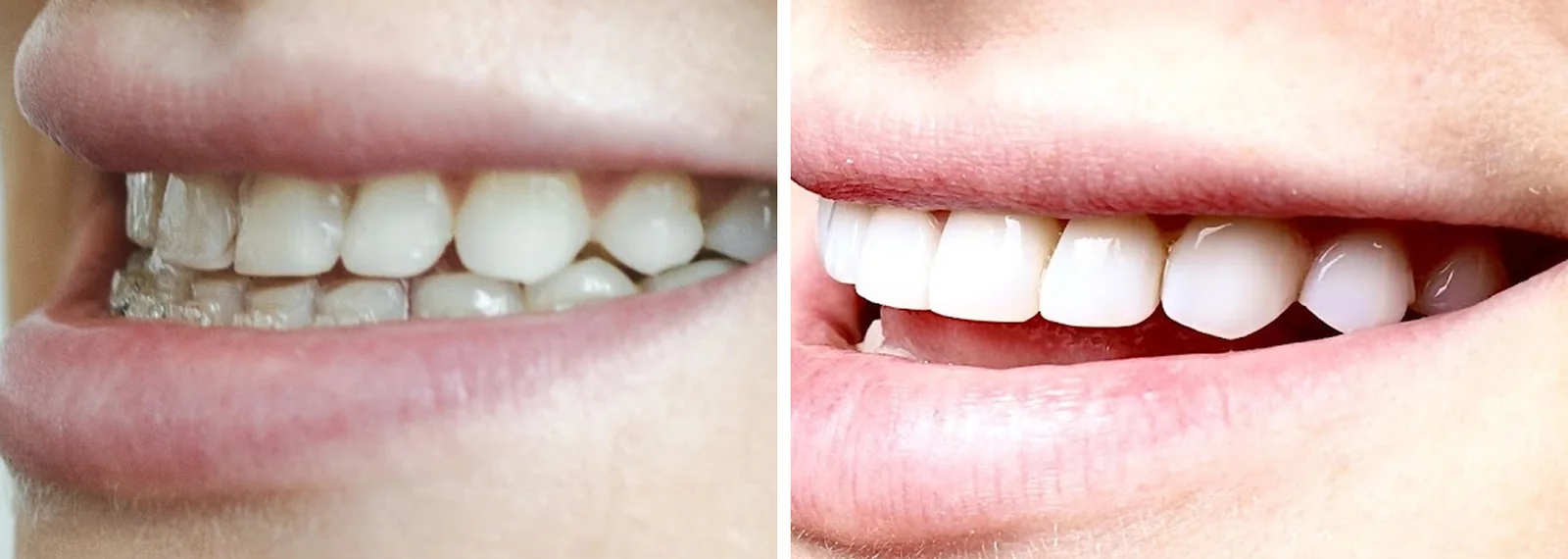
Once treatment with braces is finished, it is possible to judge whether the smile still needs the shape of individual teeth corrected. Braces change the position of the teeth, but they do not rebuild worn edges and do not change the natural proportions of the crowns. Bonding lets us refine those details.
If the plan also includes whitening, we set the right order. First we lighten the teeth, then we usually keep about two weeks of pause, and only then do we choose the composite shade and carry out the restoration.
There are two reasons. The composite shade is chosen once, and whitening agents act on it differently than on enamel. On top of that, for a few days after whitening the enamel still holds active oxygen residues, which disturb the curing of the bonding system and weaken the bond. So the pause matters both for the colour and for durability.
Not sure whether this is the right solution for you? Book a consultation
How the procedure works
Consultation and planning
We talk about what you want to change and what result feels natural to you. We examine the teeth, the gums and the bite, then agree the extent of the restoration and the way the surface will be prepared.
Laser and adhesive preparation
We prepare the working field, with care for protection against moisture. We treat the surface with the Er:YAG laser, then etch and apply the bonding system.
Layered composite modelling
We apply composite in the chosen shade, gradually building the shape of the restoration. Each layer is cured with light.
Finishing and polishing
We check the occlusal contacts, refine the contours and polish the surface. Careful finishing is what gives the restoration its smoothness and natural gloss.
Small corrections are often done in a single visit. Whether anaesthesia is needed we assess individually, depending on the sensitivity of the teeth and the extent of the work.
What affects how long the result lasts
Patients usually ask how long bonding lasts. There is no single answer, because durability depends on several things at once, not on the material alone.
In the Ars Dentistica Adhesio+ protocol every stage counts. The laser is responsible for preparing the surface, but durability is also decided by the adhesive procedure, protecting the working field from moisture, the way the composite is layered, the finishing and the occlusal conditions.
On the patient’s side, daily hygiene and regular check-ups matter. Composite can lose gloss over time, pick up stains or suffer small damage. Periodic polishing helps keep its appearance, and if needed the restoration can be repaired or adjusted locally, without replacing the whole of it.
Loads matter too. Clenching and grinding shorten the life of any restoration, porcelain included. If we find them, we take that into account in the plan and in the recommendations.
Who performs bonding at Ars Dentistica in Kraków
Composite restorations and bonding are handled by Magdalena Kontrymowicz-Ogińska, specialist in conservative dentistry with endodontics and head of the clinic, licence to practise number 2240370.
Aesthetic treatment of the front teeth is also carried out by Małgorzata Zając. Conservative dentistry procedures are performed by Dagmara Wilczyńska, Magdalena Mika and Lala Hassan as well.
We see patients in Kraków, at ul. Zamknięta 10 in Podgórze.
Book a consultation
If you are considering bonding, we invite you to a consultation at Ars Dentistica in Kraków. We will assess whether laser preparation and composite restoration are right in your case.
We will go through the extent of the change, the way the teeth will be prepared and the cost of treatment. We will also say plainly if another method is the better choice.
BOOK AN APPOINTMENT
Have a question about your own case? Book online or call us, and we will work out what comes next.
Frequently asked questions
How much does teeth bonding cost?
Veneering a tooth with high aesthetic composite costs 800 PLN. Veneering with recontouring, that is full bonding, costs from 1150 to 1350 PLN per tooth. The same procedure in the Adhesio+ by Ars Dentistica protocol, in which the enamel is prepared with an erbium laser instead of a bur, costs 1400 PLN per tooth. For four teeth the indicative cost is from 4600 to 5400 PLN, and for six teeth from 6900 to 8100 PLN. We give a detailed quote after the consultation.
Does bonding damage your teeth?
In many cases it does not, because the improvement comes from adding material rather than from removing tissue. The surface of the tooth does need to be prepared for the bond with the composite, and that applies to every method. In the Ars Dentistica Adhesio+ protocol this stage is done by a laser, so the extent of interference follows from the settings rather than from the work of a bur.
Bonding or veneers, which to choose?
For a small shape correction bonding is usually enough: it costs less, it is done in a single visit and it does not require removing enamel. Porcelain veneers are more durable and less prone to staining, but classic veneers require the teeth to be prepared by removing part of the enamel, which cannot be reversed.
Does the laser replace etching?
No. In the Ars Dentistica Adhesio+ protocol we etch the enamel after the laser preparation and apply a bonding system. These stages serve different functions and complement each other.
Does bonding with a laser hurt?
Many small corrections can be done without anaesthesia, because laser treatment does not involve a rotating bur touching the tooth, and therefore no pressure and no vibration. Sensations do depend on the sensitivity of the teeth and the extent of the work. If anaesthesia is needed, we use it.
How long does bonding last?
There is no single figure. What matters is the size and position of the restoration, hygiene, diet and loads such as clenching or grinding. Composite needs periodic polishing, and if needed it can be repaired locally without replacing the whole restoration.
Can bonding be repaired or removed?
Composite can be repaired locally, replaced or removed. That is not a guarantee that the tooth returns to exactly the state it was in before the procedure, because the way the surface was prepared and the way the material is later removed both matter.
Can bonding be combined with whitening?
Yes, but in a set order and with a pause. Whitening first, then about two weeks of pause, and only then bonding. The composite shade is chosen once, and immediately after whitening the enamel holds active oxygen residues that weaken the bond.
Have a question that is not answered here? Book a consultation


